

Saturn Entering Aries in 2026
Before you go further: what sign is your natal Saturn?
The date and time of your birth will indicate through what sign the planet Saturn was transiting.
If you were born between April 6, 1996 - June 8, 1998, or between October 25, 1998 - February 28, 1999, Saturn was in Aries when you were born; your Saturn return is underway now.
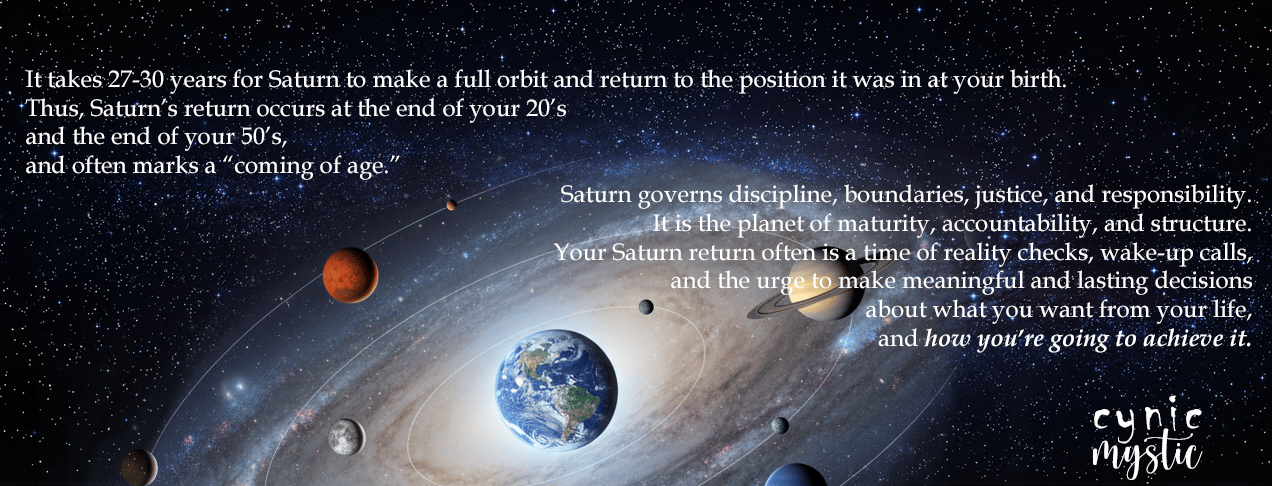
What is the impact of Saturn's return, in general?
First, you need to understand the timing. Your "Saturn return" is not a direct, one-day thing. As one of the outer planets, its route can be circuitous, and will often turn retrograde, dipping in and out of the adjacent signs during a roughly three-year transit. So this journey will be one of waxing and waning influence.
The Timing of the Lunar Phases
The Moon doesn't have to be transiting through the sign under which you were born, to affect you. For example, just because I was born with Aquarius Moon, if the full Moon coming up happens to be in Scorpio, I’m not automatically “exempt” from its effects simply because it’s not a return of my natal Moon.
In addition to what sign the Moon was in that day, it's also relevant to note what phase the Moon was in, at the time a person was born (full, waning/waxing, etc.). Specifically, being born during a new or full Moon will have different energies to contribute.
Chart analyses should also consider whether the person was born during the day or night. This concept is known in astrology as "sect" - the idea that being born while the Sun is above or below the horizon will influence the other placements. The Moon is more influential in a nocturnal chart than a diurnal one.
A Primer on the Moon's Movement and Mechanics
The ecliptic is the term for the 360° path that the Sun and other celestial bodies appear to follow as they travel around the Earth. (Today, of course, we know that the Earth actually orbits the Sun, not vice versa – but ancient astronomers observed and measured what they could with what they had.)
I find it fascinating that the original concept of the ecliptic was inherently inaccurate – and yet, was still able to actually lead scientists to realize our galaxy is heliocentric. The human capacity for discovery is so lit! 😍
So, of course when we talk about a luminary or a planet “crossing the sky”, we are referring to a human visual perception of the ecliptic.
The Moon actually does orbit the Earth, of course, and takes roughly 29 days to complete a full circle.
The start of this cycle is the New Moon – when the Moon is at 0°00’ on its orbit, and is exactly conjunct with the Sun (which prevents us from seeing any illuminated portion from Earth).
Of course, the Moon is still there, even if we can’t see it. During a New Moon, energy from the Sun is still passing in a direct line through and around the Moon to Earth.
Ironically, even though the New Moon phase is when we can see the least of her, this is actually when the Moon is closest to the Sun and receiving the most of its energy.
How the Zodiac Fits In
The zodiac is the name for the 360° “belt” that follows the ecliptic, and which is divided into 30° segments that we know as the 12 signs – Aries, Taurus, Gemini, Cancer, Leo, Virgo, Libra, Scorpio, Sagittarius, Capricorn, Aquarius, Pisces. The moon is always in one of the 12 signs, and takes about 2.5 days to transit across to the next sign.
So, at any given time, the Moon is in a degree of its own 360° orbit (which could be anywhere from 0°00’ to 359°59’) and also in a degree of a zodiac sign (which could be anywhere from 0°00’ to 29°59’).